


Should I Use AI in My Startup, with Suyash

Joining us at the Bay Area this Summer, Suyash brought his expertise in AI and ML to the students at our Bay Area Entrepreneurship Program in 2025.
Artificial Intelligence has become a staple for many entrepreneurs in recent years. Since the release of ChatGPT in 2022, AI has become a powerful tool for faster ideation, exploring new concepts, serving as a companion, and assisting with code building.
But should you use AI on every new venture? We sat down with a LaunchX Speaker and expert in AI to help understand the Artificial Intelligence and Machine Learning landscape and how entrepreneurs should leverage these new systems and tools.
Should Artificial Intelligence (AI) and Machine Learning (ML) be used in every startup?
This foundational question appears to trip up many youth entrepreneurs. They identify a new trend or technology that they can leverage and assume that using it will only enhance their product or offering.
But AI should be used as just that – a tool. When using or integrating AI into your product or service, you are using 1 of many tools that you can include. This is no different than asking if your tools should be connected to the internet – it depends.
Are you designing a backpack? It probably doesn’t need internet access, let alone AI. There are smart use cases for AI in products and services, but it should ultimately enhance your product and company by serving your customers well. If it isn’t doing that, it is probably not necessary.
It’s also important to clearly distinguish the general field of Machine Learning, & LLMs. Large-Language-Models are one of the newer solutions to the problem of text-generation & understanding. We’ve had machine learning systems since forever, & LLMs are just one of the types of ML models.
Large generative models can sometimes feel like a silver bullet for all problems - but they shouldn’t be treated as such. You can use LLMs to automatically parse & understand large documents, do reasoning, rank a set of results, … But, they may not be the most optimal solution for all of these things.
You have to make these decisions in sequence:
- Can you write an algorithmic solution to your problem, or do you need ML?
- Can simpler ML models cut it, or do you need LLMs?
- If you’re using LLMs for some parts of the software run, can you later move to simpler ML models, or hard-coded options?
When does it make sense to use ML?
Suyash recommends considering Machine Learning only when the process you are working on can’t be explained in 10-20 steps. If you can outline the process you are attempting to accomplish within 20 steps, ML is probably overkill, and using a more traditional algorithm should work.
Similarly, if you are attempting to get a computer to perform a task that it is traditionally not well-suited for, such as reading images or characters, integrating ML could be a smart next addition to your product. Other examples can be understanding complex user interests, robot navigation using camera inputs, etc.
What are the caveats with AI?
- By their very implementation, LLMs are great at understanding & generating long text for unpredictable inputs. But when it comes to predictable, repeated processes, LLMs are inefficient. Just code it if possible
- Further, you will most likely be utilizing a cloud provider, and costs can easily skyrocket, especially if part of the system encounters bugs that make it even more inefficient.
- LLMs have no memory inherently. When you send a question, the system usually sends a “context” automatically. In ChatGPT, it is the history of your conversation – in coding agents, it’s some details about the project & large chunks of the code. The problem is that all current LLMs have a limit of how much “context” they can process at once, & they also don’t “notice” all parts of the context equally. So, the longer the chat, or the larger the code, the more mistakes it will make
Should I utilize LLMs and AI tools to assist me with coding?
Using AI as a coding companion can certainly offer efficiency gains when used correctly. A great example of using AI wisely is building a portfolio website. This is usually a time-intensive task that can be quickly spun up with AI tools, such as vibe-coding tools.
Websites like portfolio websites are also known for being simplistic in functionality. This simplicity becomes an asset when attempting to get a black-box system like vibe-coding to function correctly.
However, the more complex the project is, the more understanding of the information architecture you will need. Furthermore, if you build a complex system that can be made functional through an AI tool, you may be able to run the system in the short term; however, it is possible that the system will become so complex that bugs will become challenging to address and will not be scalable. One of the well-known issues with coding agents is that they generate redundant code. They can implement a commonly used functionality in 10 different places instead of importing and reusing. Also, the bigger the code base gets, the harder it is for the LLMs to take it all in context at once.
The dynamic usually has to be something like a manager-intern relationship. As the code owner, & expert, you have to make sure you enforce good coding practice, segregation, etc. Think of the LLM agent as an exceptionally good intern, who can do small tasks well, but needs guidance for longer tasks, & for the sake of code health, debuggability, etc.
This is not strictly a problem, though, from Suyash’s perspective. If you are building something quickly to get it out to market as a proof-of-concept, AI can give you an unfair advantage in speed. Be aware that if you gain traction, you may need to start from scratch to build a more stable and scalable product. It’s also, however, important to learn, at a high level, precisely what the generated code is doing, & where. If you’re just starting with coding, it will help you learn as you go & make you better able to manage the project when it gets big.
Wouldn’t it just be easier to avoid AI?
When enhancing your product or taking it to market, you need to do what is best for your customers. That may mean not incorporating AI in the long run..
Suyash warns that ML will not solve every problem, so don’t try to use ML to do that. Instead, he suggests that understanding AI and ML as tools can help you know when and, more importantly, why to use them.
Introducing AI into your system or product will make it less accurate and more inefficient in the long term. The way that large language models work will introduce these by-products to you. You shouldn’t just avoid using them. If you understand how these tools work, you can leverage the advantages of using AI, even in the short term, to help accomplish your long-term goals.
Even if you start with an early version with LLMs, for things like ranking, parsing, etc, you can move to algorithmically coded solutions later on. That would reduce latency, and be better for privacy too..
What is the most innovative way to start using AI?
First, it is crucial to understand the common pitfalls associated with using AI. If you can get an understanding of common mistakes, you can avoid some of the most significant issues that you will face when using AI. It’s also important to understand how the specific ML model you’re using works/trains. LLMs, for example, train to generate text from a lot of text data from the internet.
Secondly, there is an excellent illustration of how to utilize AI to approach these tools smartly.
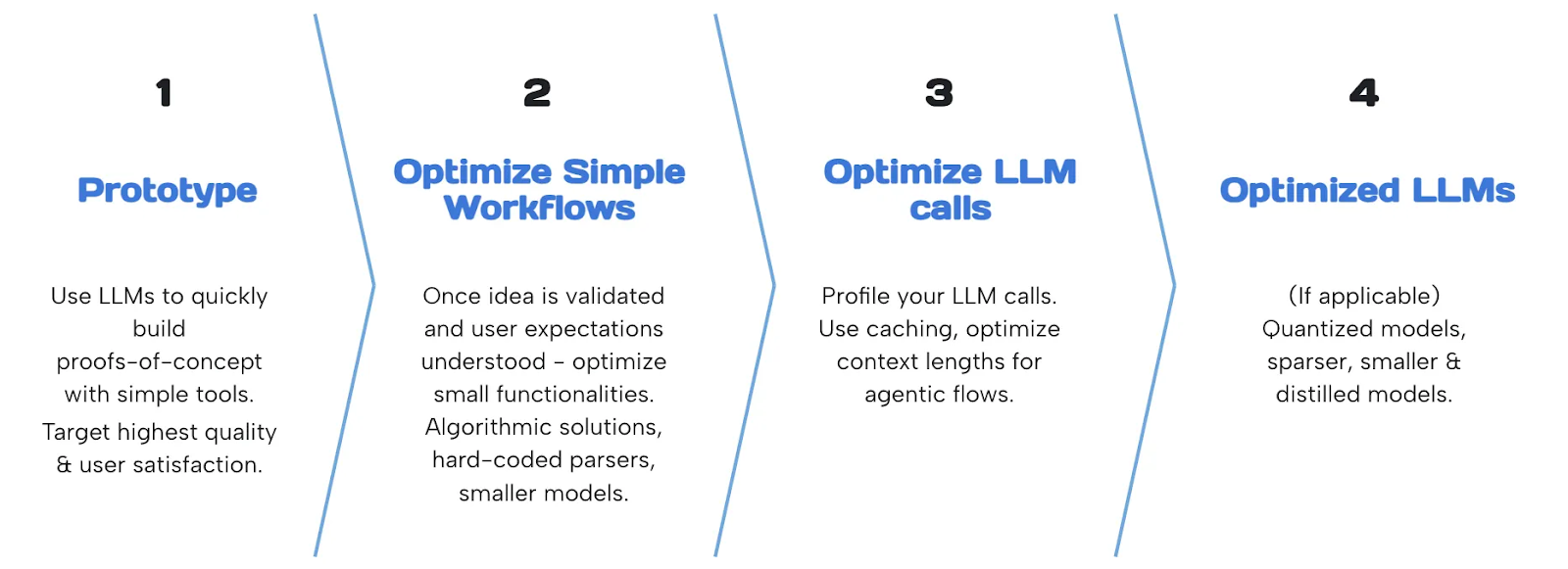
Understanding both the risks and the rewards can help you weigh the pros and cons of incorporating AI into your business, product, or service. As the landscape of AI evolves in the coming weeks, months, and years, new opportunities and challenges will emerge, presenting opportunities to build incredible products and businesses.
Want to go deeper?
Suyash has also written a longer piece exploring the tradeoffs of AI adoption, energy use, and how founders can prototype quickly while optimizing responsibly over time. Read more here.


.webp)
